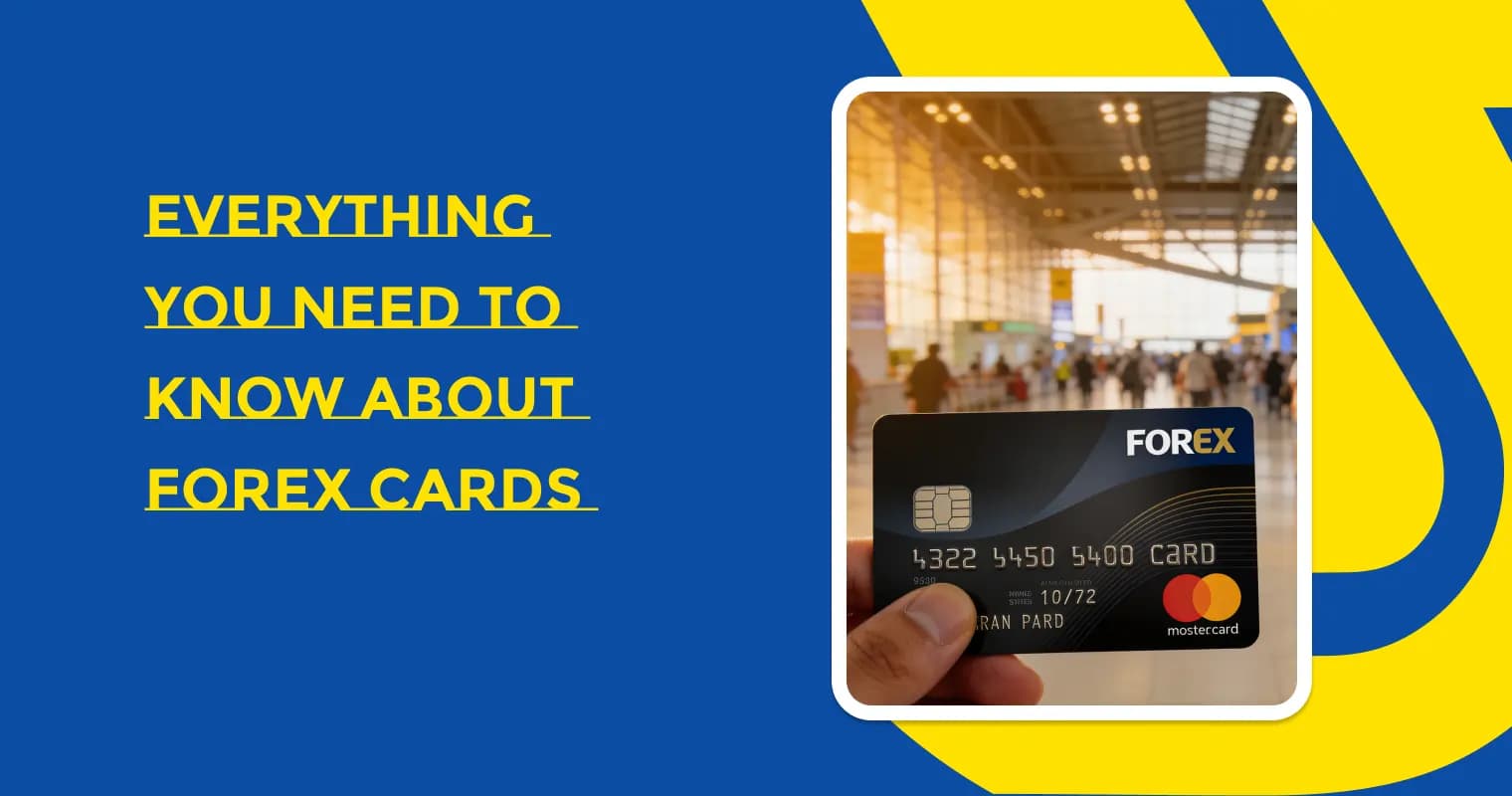
Everything You Need to Know about Forex Cards
By: TradeUCare Team
Traveling internationally is adventurous, although dealing with foreign currencies might pose a challenge. Learn everything about forex cards for international travel.
Introduction: Overview of Forex Cards
Traveling internationally is adventurous, although dealing with foreign currencies might pose a challenge that becomes complex in no time at all. While cash is straightforward, carrying too much of it poses security risks. On the other hand, credit and debit cards offer convenience, but the costs associated with using them internationally are uncertain due to foreign currency fees, exchange rate fluctuations, and ATM charges.
This brings us to forex cards. As its name suggests, forex card stands for foreign exchange cards. This travel card is preloaded with foreign currency before the trip begins. It allows you to pay for shopping, hotels, restaurants, and online bookings, as well as withdraw money from ATMs abroad. Forex cards issued in India are mostly issued by banks or authorised foreign exchange companies and must adhere to RBI and FEMA regulations related to international travel.
While some individuals prefer more advanced cards than others, the best forex card should match your destination, requirements, reload capacity, charges, and how frequently you use the card.
What is a Forex Card?
Forex cards are prepaid cards that facilitate loading of foreign currency, which can then be spent abroad when traveling. These cards resemble debit cards, except that their foreign currency value is not drawn from your savings account directly.
For instance, if you travel to the US, you can preload your card with US dollars. In case you are traveling within Europe, you can either preload euros on your card or opt for a multi-currency card that holds multiple currencies. Forex prepaid cards have been commonly referred to as reloadable travel cards that can be used abroad for purchases, cash withdrawals, and eligible online transactions.
The core concept is quite straightforward. You simply preload the card with your intended currency, travel abroad, and make purchases with the local currency without carrying too much cash. Additionally, since the amount of money is already loaded, it makes it easier for you to manage your budget.
How does a Forex Card work?
The forex card is based on a prepay system. You decide the currency you would like to carry, top up the card with funds, and start using the card in foreign countries where it can be used.
Typically, the process is like this:
- You apply for a forex card from banks or other authorised provider.
- You provide them with the necessary KYC and travelling documents.
- Your forex card is loaded with foreign currency.
- You make payments in foreign countries through POS terminals, ATMs, and online merchant websites where the card is applicable.
- The transaction amount will be deducted from the total loaded amount.
In case your forex card is loaded with dollars, any payment made in the United States will be deducted in USD. If your multi-currency forex card is used in another country where the currency is also loaded, the card normally deducts the payment from the loaded foreign currency.
Online reloading of forex cards is also possible via internet or mobile banking facilities.
How to Apply for a Forex Card
There are many travelers who are looking out for information on how to apply for forex card as the process may vary a little from bank to bank. In general, there will be no complications if you possess all the necessary travel and KYC documents.
This is generally what the procedure involves:
- Choose a bank or forex card issuing company.
- Choose the right type of card, based on your currency requirements and destination.
- Fill up the application form online or offline.
- Provide your KYC details and other travel-related documents.
- Choose the desired currency and the total amount that you would like to load onto the card.
- Pay the money in Indian rupees.
- The card will be delivered to you physically or as per the provider's process.
Alternatively, you could use internet banking to apply for forex card. Many providers enable people to apply for cards using internet banking websites or their mobile applications. The time taken for delivery could differ from case to case.
Before applying, find out about the charges applicable like issuance fee, reloading charges, ATMs withdrawal fee, currency conversion charge, refund charges, and others.
Documents Required for Acquiring Forex Card
The following is a list of some commonly asked documents required for obtaining a forex card in India. However, please note that specific documents required may vary from one bank to another.
Documents generally asked for:
- Copy of passport
- Copy of visa (wherever applicable)
- Copy of air ticket or travel itinerary
- Copy of PAN card
- Proof of address
- Forex card application form
- Form LRS or other forms required by the issuer
- Payment details / Bank account details
A person applying for forex card in India is supposed to be a resident Indian travelling abroad and should have fulfilled the KYC norms along with the necessary travel documents like passport, visa, and travel itinerary.
RBI guidelines on money changing also state that authorised dealers or FFMCs who issue forex cards for travel purposes must conduct due diligence and satisfy KYC norms similar to what they follow when issuing foreign currency notes or travelers cheques.
What are the different types of forex cards?
Various types of forex card options can be used according to how and where you intend to use it. Your forex card choice should depend on your traveling purpose; whether it is only one country or several countries, educational purposes, business purposes, or frequent travel purposes.
Some common forex card choices include:
- Single-currency forex card: Suitable for a traveler intending to visit only one country or single currency region.
- Multi-currency forex card: Useful in cases where you intend to travel to several countries or use more than one currency.
- Student forex card: This forex card will suit students who wish to go to another country for studies.
- Business forex card: Ideal for professionals or company employees who need to travel to other countries for business purposes.
- Premium travel forex card: These may have added value such as travel benefits, customer care services, insurance, or reward-linked benefits.
- Co-branded forex card: Cards that may be associated with particular airlines or travel brands.
Choosing the right forex card type depends on your travel purpose, destination, spending needs, and how frequently you travel internationally.
Single Currency vs Multi-Currency Card
A single-currency forex card lets you store only one foreign currency. You can use it for international transactions that involve only one country or currency zone. For instance, if you are going to visit the United States alone, then a USD-based single-currency card would suffice.
A multi-currency forex card enables you to store multiple currencies in one card. You can use it for transactions involving several countries. For instance, if you plan to visit the United Kingdom, France, and Switzerland, then you need GBP, EUR, and CHF. Instead of holding multiple cards or converting currencies repeatedly, you can use one multi-currency card.
The choice between single and multi-currency forex cards largely depends on your travel destinations, expenditure habits, and frequency of international travel.
The following table provides a quick distinction between the two:
| Feature | Single-Currency Card | Multi-Currency Card |
|---|---|---|
| Ideal for | Travel within one country | International visits to multiple countries |
| Currency capability | Only one currency | Several currencies |
| Risk of cross-currency rates | Higher if used outside loaded currency | Lower if required currency is loaded |
| Convenience | Easier to manage | More flexible |
| Suitable for | Short trips | Long trips, tours, students, business travel |
What are the benefits of a forex card?
Some of the primary forex card benefits that it offers can be listed below:
- Safety compared to carrying an excess amount of cash: In case the card gets lost, it will be easier to freeze it and get a replacement card.
- Ability to control your budget: It will be possible to add a specific amount of money onto the card and monitor your expenses.
- Convenience while traveling abroad: The forex card can be used in retail stores, hotels, ATMs, and other locations depending on its validity period.
- Option for multi-currency payments: Sometimes, some forex cards can have multiple currencies on the same card.
- Less impact of currency fluctuations: When loading a forex card, the exchange rate will often be fixed.
- Practical for Indian students: The card can be recharged remotely by parents from India even when the child stays abroad.
- Possibility to recharge the card quickly: Recharging procedures are easy since they can be conducted through online channels.
Overall, a forex prepaid card can be useful for students who travel abroad for educational purposes.
Do's & Don'ts of using a forex card
Forex card should be made efficient only if used properly. The following tips for using cards abroad can help you to avoid extra expenses while using card in foreign countries.
Do's
- Make sure there are no charges before purchasing a card.
- Fill the card with correct currency according to your travel plan.
- Carry a small amount of local currency for taxi fares, tipping, and small purchases.
- Make a note of emergency number provided by the issuer of the card.
- Use the ATM available in the bank, airport, etc. which is more secure.
- Check your card balance regularly.
- Carry alternative means of payment in case of any problem.
- Intimate card issuer before traveling, if required.
- Top up the card if your balance is low.
Don'ts
- Don't use the card in India for any local transaction unless stated otherwise.
- Don't reveal card PINs, CVV numbers, OTPs, or login information.
- Don't disregard cross-currency charges.
- Don't withdraw money from ATMs often when high ATM charges apply.
- Don't let your unutilised balance remain unused for too long post travel.
- Don't use questionable ATMs.
- Don't take it for granted that all foreign merchants accept prepaid cards.
The RBI states that these prepaid cards can be used for permissible transactions in current accounts only and are eligible for LRS limits as applicable.
Why So Many Travelers Are Switching to Forex Cards
A lot of travelers from other countries have started using forex cards since forex cards provide a more systematic approach towards dealing with money during travel. Travelers do not need to carry excess amounts of cash or rely solely on their credit cards for spending.
Moreover, the transition towards forex cards has been furthered due to some practical reasons as well. Individuals desire better control over the exchange rate, less confusion regarding bills, and better safety while making payments abroad. Another advantage of forex cards is that the cardholder does not exceed the limit of the pre-loaded amount.
The attraction for students is even greater. The parents can recharge or reload the card with money from India, and the student can use the card while studying abroad for all expenses, food, books, trips, and online transactions. This is the reason why most families try to find the best forex card for students when their kid studies abroad.
If you wish to choose the best forex card for international students, it would be better to check the aspects such as ease of reloading, supported currencies, emergency support, replacement procedures, ATM fees, and options for online transactions. If you belong to an Indian family, you may consider finding the best forex card for students India.
Conclusion
A forex card makes international travel hassle-free, safe, and organised. With a forex card, travelers can hold foreign currencies digitally and use them overseas more conveniently while reducing their reliance on hard cash.
But the best forex card in india for someone may be different from the right forex card for another. The needs of an individual traveling to only one country could be met with a basic single-currency card. An individual studying abroad might want a reloadable card. One who travels for work purposes would want a multi-currency card.
Before you get a forex prepaid card, look into its fees, currency coverage, ATM fees, refund policies, and customer service. Moreover, one should ensure their use of the card complies with RBI, FEMA regulations, and those of the issuer.
A forex card isn't merely a travel product. Rather, it is an effective money management product when used wisely.
FAQs
Almost all issuing banks permit users to reload their forex cards via online banking, mobile banking, bank branches, and authorised forex sites. You have to choose the card from your account, select the foreign currency, enter the amount you wish to reload, submit the necessary information, and then complete the transaction.
Search
Categories
- Currency Exchange4
- Travel Tips5
- Money Transfer3
- Forex Trading1
- RBI Guidelines1